A runway show can be remembered for the clothes, the casting, the lighting, or the moment a look reaches the end of the catwalk. But some of the most electric moments happen when fashion stops existing on its own.
During Runway 7’s September 2026 season, live performers became part of the pulse of the show. They shifted the atmosphere, gave guests another way to connect with what was happening around them, and created moments that extended beyond the collections themselves.
Their presence mattered because live performance introduced something fashion could not create in exactly the same way. A voice, an instrument, or a suspended entrance could alter the pace almost instantly, turning the catwalk from a sequence of looks into something more immersive and unpredictable.
That is what made these performers such an important part of the season. They were not simply there between fashion moments. They helped shape them, adding another layer of expression to Runway 7 and making the show feel larger than the clothes alone.
Above the Catwalk
Some performances changed the mood. The aerialists changed the way the entire space was seen.
Their work pulled attention away from the traditional runway line and upward. The catwalk remained at the center, but suddenly the ceiling, lighting rig, open air, and suspended hoops became part of the composition. What normally existed above the audience as background architecture became part of the show itself.
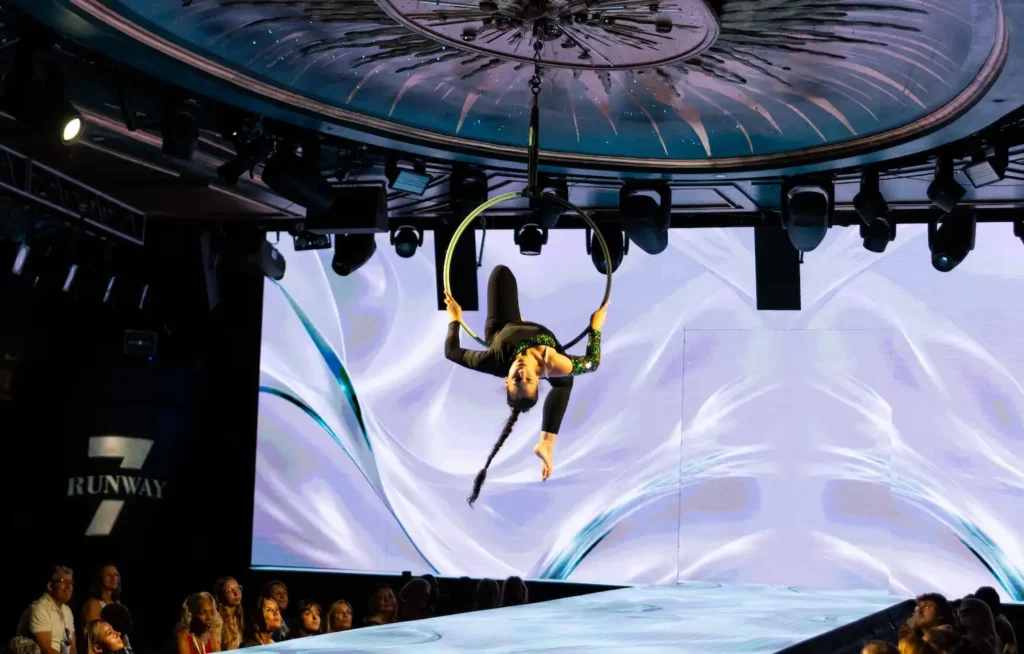
Jasmin Cicchino changed that perspective almost immediately.
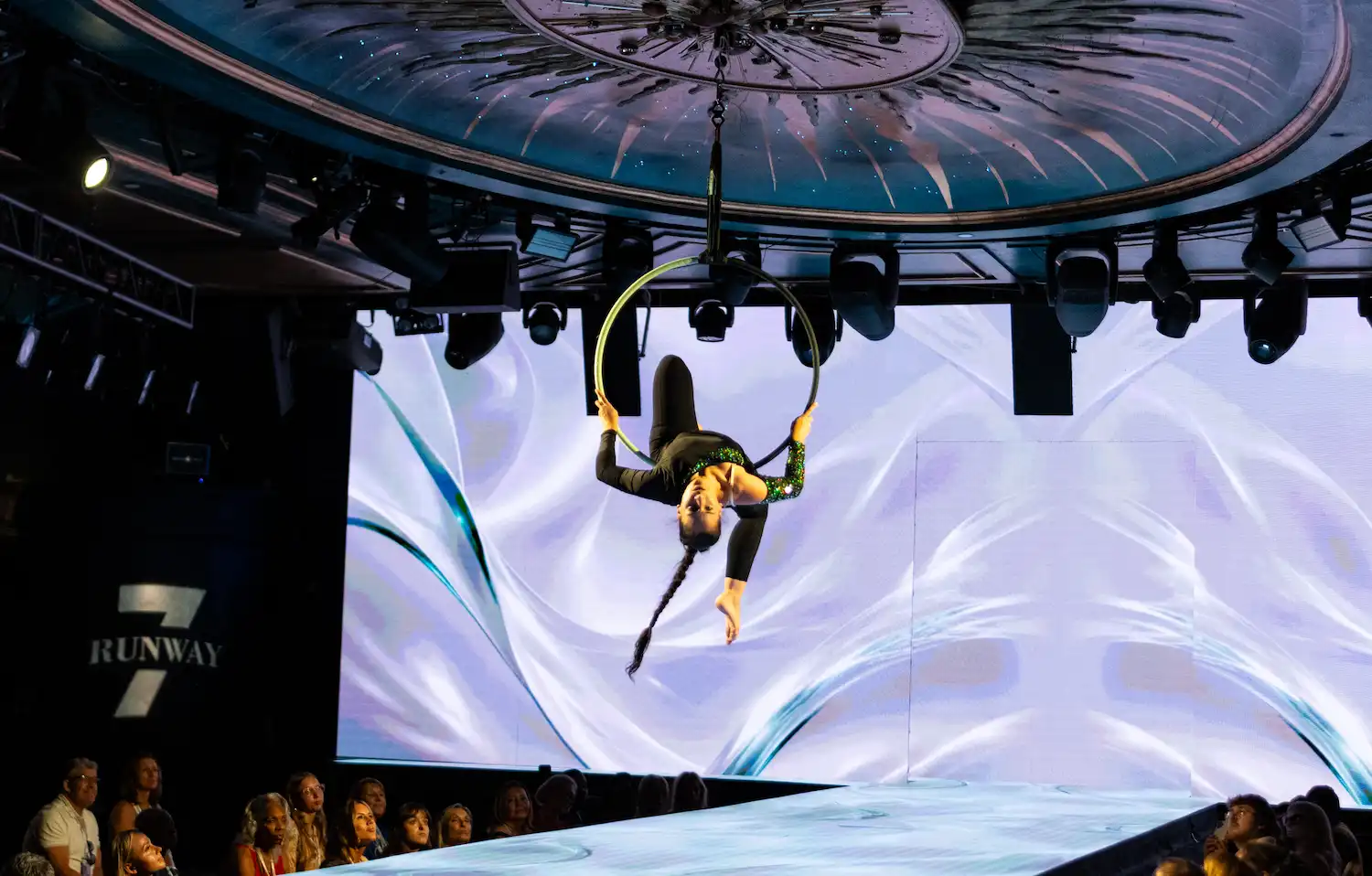
Suspended above the catwalk on an aerial hoop, she introduced a different sense of scale. Her positions created long, controlled lines that extended beyond the circular frame of the apparatus, while inverted shapes and curved poses changed the silhouette from one moment to the next.
There was a striking contrast between the difficulty suggested by those positions and the calmness with which she held them. Her black costume kept the overall form clean, while iridescent detailing caught brief flashes of light as she moved. Even her long braid became part of the picture, following the direction of her body through inverted and suspended positions and making each shift more visible from below.
Jasmin’s presence expanded the audience’s field of vision. For a few moments, the fashion remained below while another performance unfolded overhead, occupying a part of the venue that a traditional catwalk rarely touches.
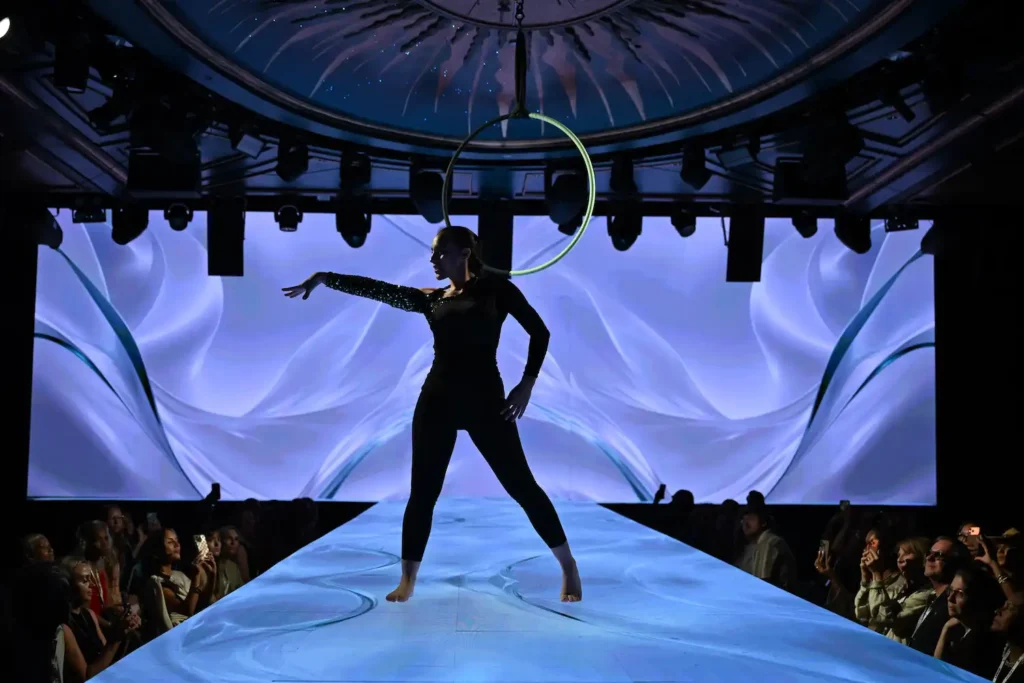
Yueyue approached the same apparatus with a noticeably different language.
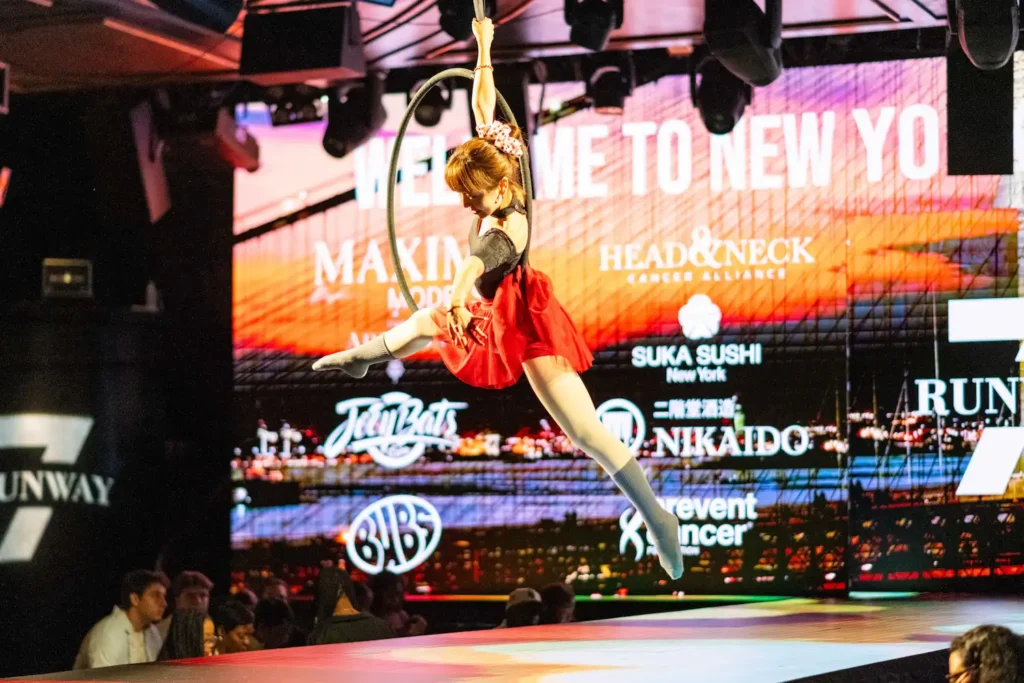
Inside the aerial hoop, she relied on long extensions, deep curves, and open body lines that gave her performance an almost balletic quality. Rather than emphasizing stillness, her shapes seemed to flow into one another, changing the composition around the hoop as her body shifted.
Her styling amplified that quality. The red skirt moved outward during extensions and rotations, adding volume around her body and making each transition more visible across the venue. Against the dark hoop and black upper half of the costume, the red became an immediate focal point, while the lighter legwear emphasized the length of her lines.
Where Jasmin brought precision and control, Yueyue introduced softness, curvature, and expression. Together, they showed how two performers could use the same aerial apparatus and create completely different atmospheres.
That contrast is exactly what made the aerial moments so effective. They did not compete with the fashion below. They expanded the world around it.
For those moments, the runway was no longer limited to the floor.
A Voice in the Room
After the aerial performances opened the space above the catwalk, the focus shifted back down with an entirely different kind of presence.
Jaya Leslye brought live vocals into the center of the show, creating a more immediate connection with the people watching.
Microphone in hand, dressed in black and framed by a vivid red-and-dark LED environment, she commanded attention through presence rather than spectacle. Her long braids, statement eye makeup, strong stance, and minimal styling gave her a distinctive silhouette without pulling focus away from the performance itself.
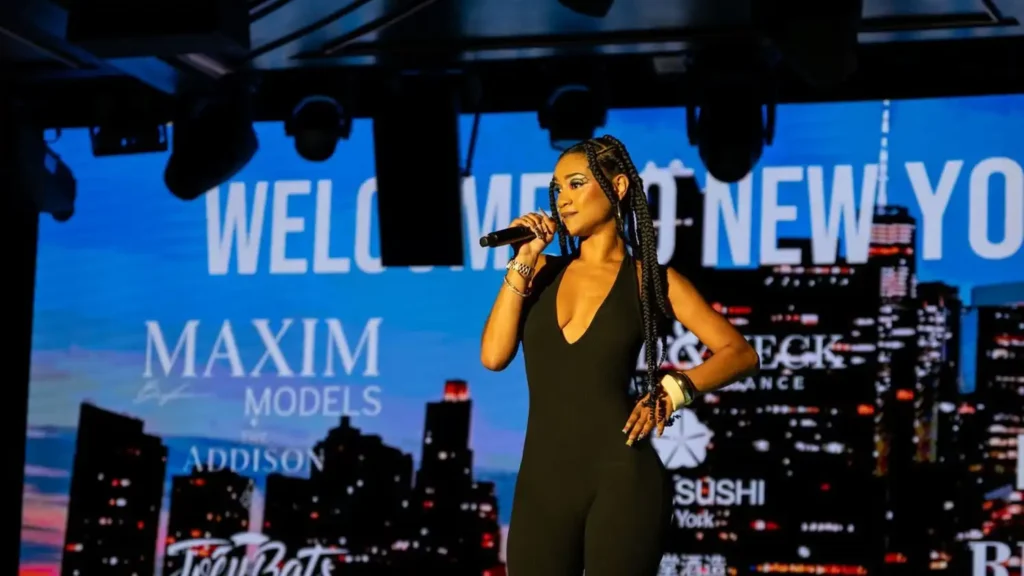
There was a grounded confidence to the way she occupied the stage. Unlike the suspended motion that came before her, Jaya’s strength came from being firmly present in the same space as the catwalk and the audience. Her voice gave the room a new focal point, changing not where people looked, but how the moment felt.
Aerial performance could expand the physical boundaries of the show. A live singer could change its emotional temperature.
Jaya brought intensity through sound, expression, and direct presence. Her set created a pause in the usual visual rhythm of fashion and allowed the audience to connect with something more immediate and human.
For those few minutes, the runway did not just have a look.
It had a voice.
Rhythm in Motion
From voice, the show moved into another kind of live sound.
Jax Coopersmith brought the saxophone onto the catwalk, but his approach was far from a quiet or traditional jazz interlude.
His style was more active, more animated, and closely connected to the pace of the event. Rather than remaining static and allowing the instrument alone to carry the moment, Jax used his physicality as part of the performance, bringing a stronger sense of momentum to the stage.
That changed the character of the saxophone entirely. An instrument often associated with smoothness, restraint, or classic jazz suddenly felt more dynamic. Jax pushed it toward something contemporary and energetic, better suited to the fast-moving atmosphere of a fashion show.
Visually, the setup reinforced that direction. Dressed in black against a vivid backdrop filled with color and musical graphics, he stood as the focal point at the center of the catwalk. The saxophone introduced warmth and richness to the sound, while his movement prevented the performance from ever feeling still.
That contrast became one of the strongest aspects of his appearance: the sophistication of the instrument paired with a much more kinetic way of performing it.
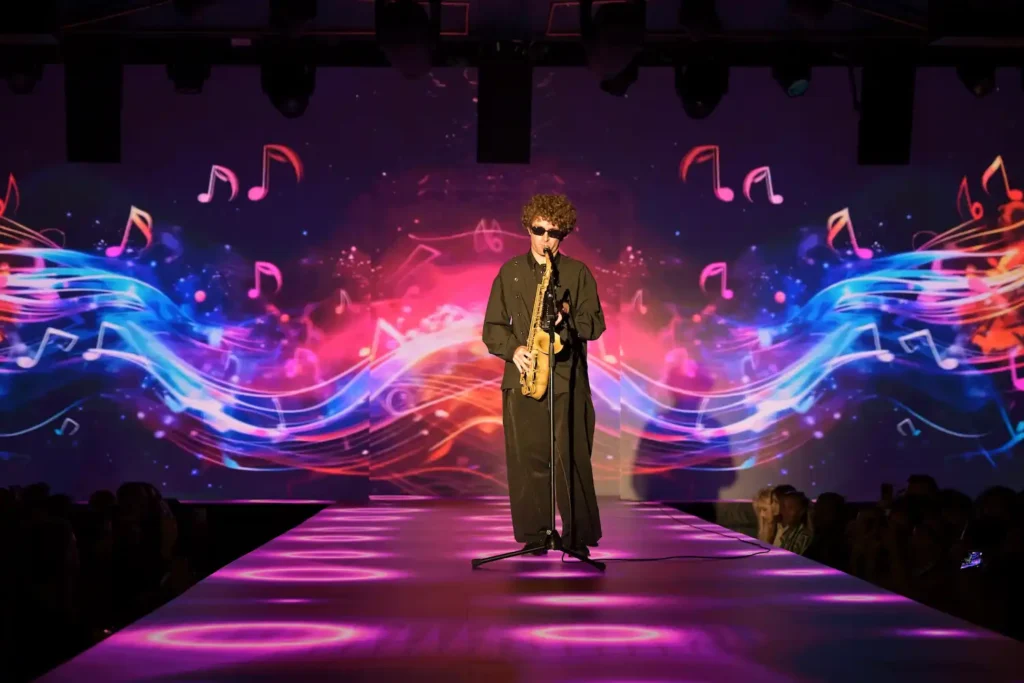
Jax did not simply add music to the show.
He changed its tempo.
Live saxophone also became part of the season through Cleo Fox, who joined the CH!CK show. Her presence added another layer of live instrumentation to the presentation, reinforcing how sound could become part of the identity of an individual runway moment rather than simply sit behind it.
The Sound Between Shows
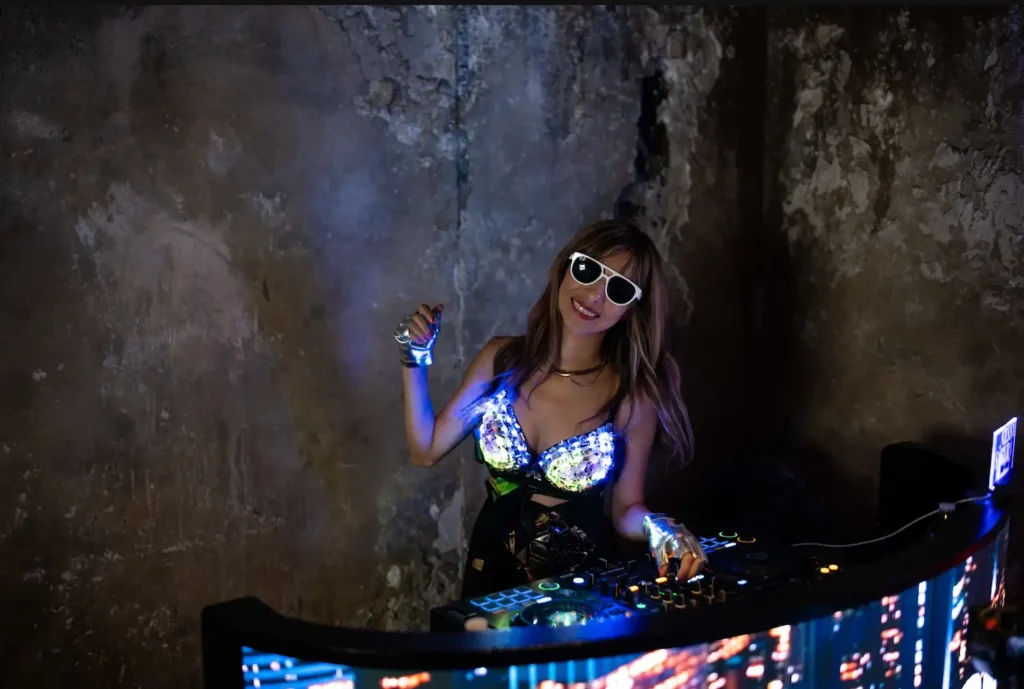
Music also remained present beyond the featured live performances. Across the September 2026 season, Nessa Sakura, DJ ER!C V!SA, NYC, and DJ TONE contributed to the soundtrack surrounding Runway 7, helping maintain the pace and atmosphere as the shows moved from one moment to the next.
Their presence was another reminder that sound plays an important role in how a runway is experienced. The music surrounding the catwalk can build anticipation, carry momentum between presentations, and help define the energy guests feel before the next look even appears.
Beyond the Runway
What connected these performances was not style, sound, or discipline. It was what each of them added to the world of Runway 7.
Jasmin and Yueyue opened the space above the catwalk and made the architecture itself feel alive. Jaya brought the focus back to the stage through voice and presence. Jax shifted the tempo again, turning live instrumentation into movement and momentum. Cleo Fox added another live musical dimension during the CH!CK show, while Nessa Sakura, DJ ER!C V!SA, NYC, and DJ TONE helped sustain the sound and pace surrounding the season.
Each contributed to the atmosphere in a different way, and that is exactly why live performance matters within our shows.
Fashion will always remain at the heart of Runway 7, but the experience does not have to end with the clothes. Performance can stretch the boundaries of the runway, interrupt expectations, change the pace of a room, and give the audience something they could never experience through images alone.
The performers of September 2026 reminded us that some of the strongest moments happen when different creative worlds are allowed to exist together.
The runway can carry fashion.
But when performance enters the space, it can carry something more.
For singers, musicians, aerialists, dancers, DJs, and other live performers interested in becoming part of a future Runway 7 season, the opportunity to bring that talent into the show is open. Whether your work is built around sound, movement, stage presence, or a performance style entirely your own, we are always interested in discovering artists who can add something distinctive to the experience.
If you would like to be considered for an upcoming Runway 7 show, submit your application HERE.