At Sony Hall, HIV Unwrapped brought fashion, science and personal storytelling into the same room, moving from an international runway presentation to ten new collaborations inspired by HIV scientists and researchers in the United States.
An Opening in Red
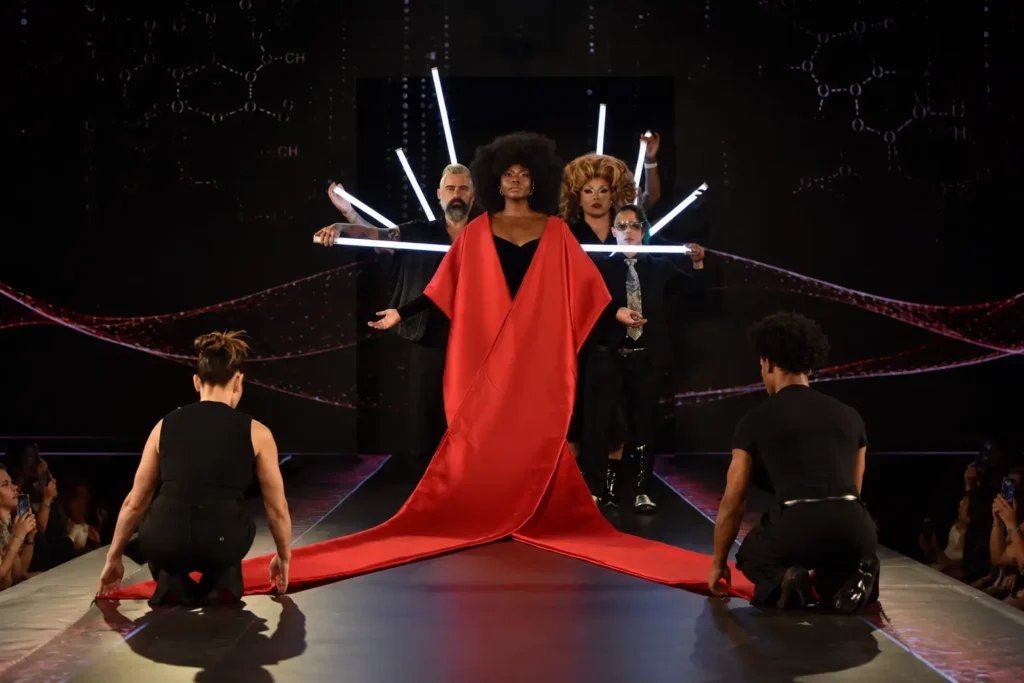
For the first few moments inside Sony Hall, it was difficult to know exactly how HIV Unwrapped was going to begin. Then the lights shifted and soprano Kristin Renee Young started to sing. Her voice filled the room before a single collection look appeared, immediately moving the presentation away from the rhythm of a conventional runway show.
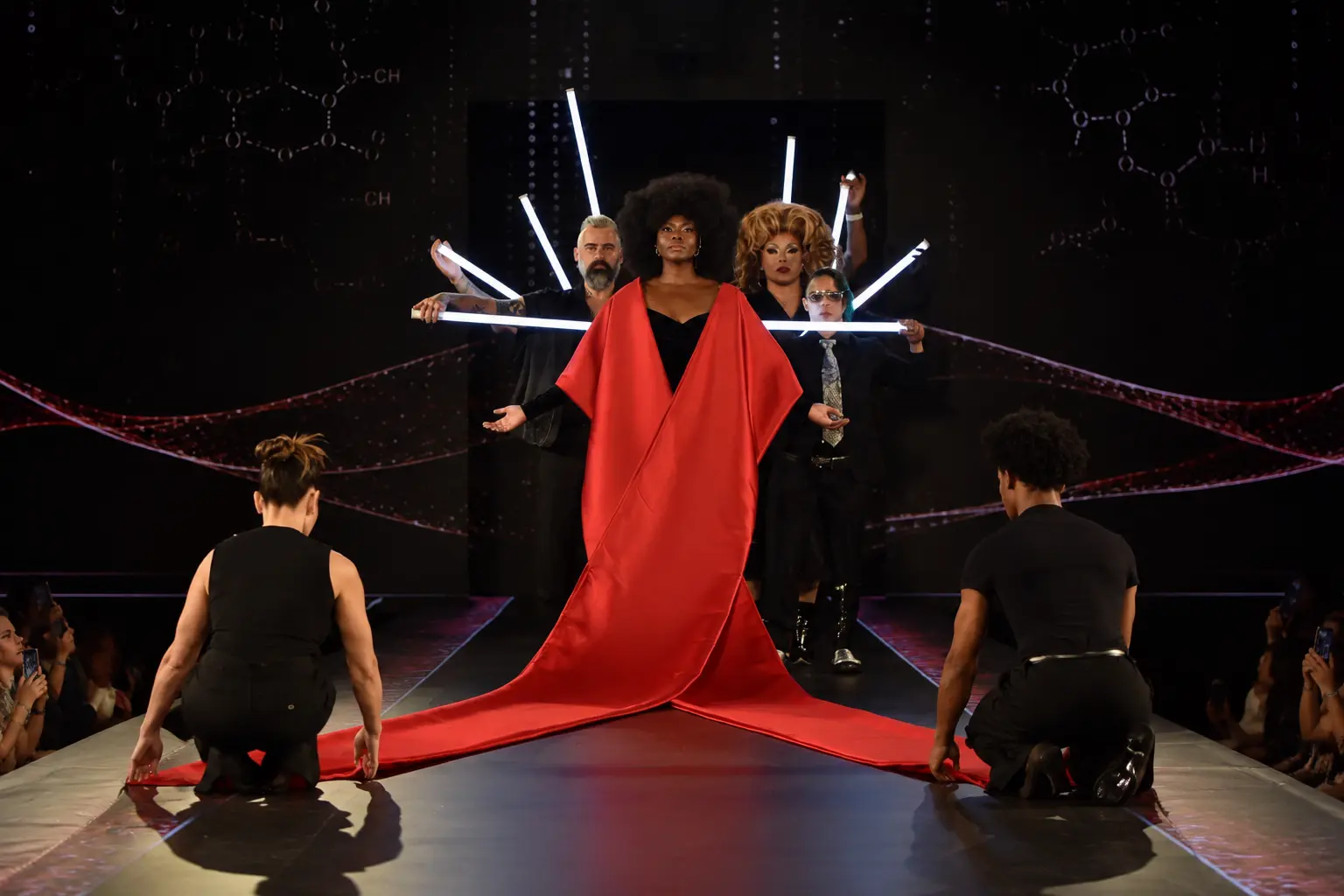
As she continued singing, two models entered carrying a long piece of red fabric. They stretched it across the runway before bringing it around Young and covering her figure in red. More performers followed, dressed entirely in black and carrying individual white lights. Moving slowly, they gathered behind her until the runway had become a composition of black, white and red.
From the audience, the opening felt closer to a live performance than a fashion entrance. It made the room quiet down and look toward the same point at once. It also established something that would remain present throughout the night: HIV Unwrapped was not going to separate the clothes from the stories surrounding them.
Setting the Story Before the Fashion
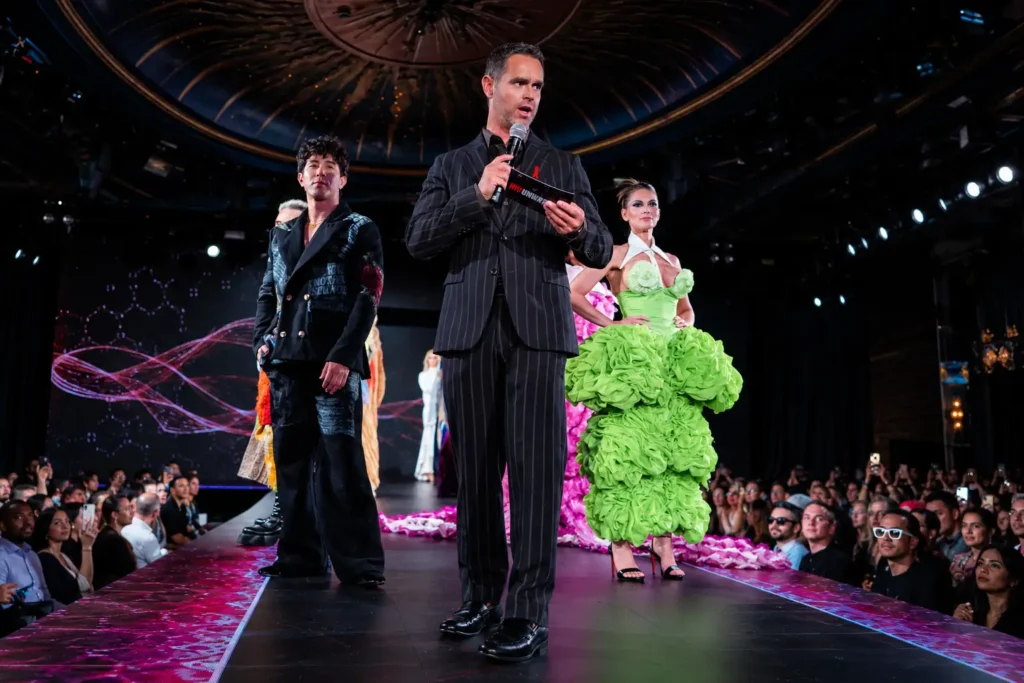
Once the opening ended, Karl Schmid took the stage and gave us the context for what was about to follow. He introduced the designers and the international perspectives represented in the first part of the presentation, with work connected to Rwanda, Sweden, Fiji, Brazil, Canada, Australia and the United Kingdom.
The conversation quickly moved beyond fashion. Schmid addressed the stigma that continues to surround HIV and spoke about turning fear into something that can motivate action. He also told the audience that people living with HIV would be walking the runway that night. The point landed clearly in the room: you cannot determine someone’s HIV status simply by looking at them.
A video presentation followed, expanding on the ideas and people connected to HIV Unwrapped. By the time the lights returned to the runway, the clothes already had a context around them. Then the international collection began.
Seven Countries, Ten Different Perspectives
Rwanda came first with a long neutral coat covered in colorful shapes, patches and oversized hand motifs. After the seriousness of the introduction, the layered, handmade quality of the piece felt like the moment the evening fully shifted into fashion.
Sweden changed the mood almost immediately. Deep blue met bright yellow in a much larger silhouette, with red cords, graphic patterns and small elements that moved as the model walked. Fiji followed with a red coat that already had presence from the front, but the real reveal came when the model turned and large patterned panels opened behind him. It was one of the first moments when movement completely changed what we thought we were looking at.
Brazil pushed the runway toward color and texture. Long electric-blue strands moved around the body while reds, yellows, greens and purples filled the upper half of the look. By then, it was clear that the international collection was not trying to force seven countries into one aesthetic. Each arrival changed the visual language of the runway.
You might be interested in reading: CATWALK FURBABY TAKES OVER OPENING NIGHT
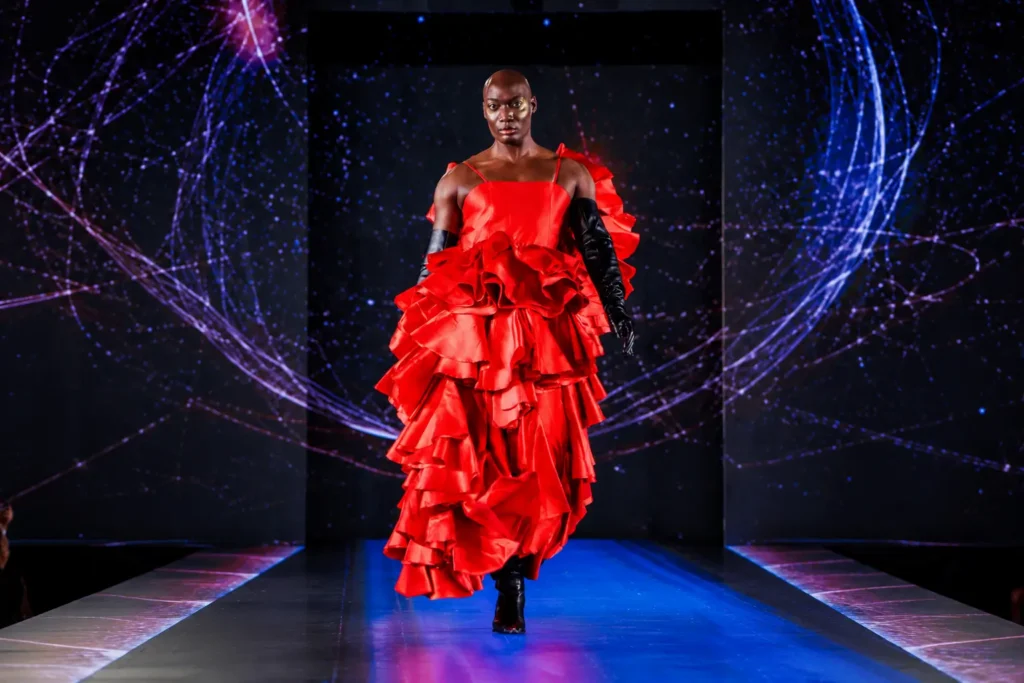
One of the biggest reactions came with an enormous red sculptural look built from large folds that expanded around the body. The garment was dramatic on its own, but the model’s walk made the moment. With every movement of the hips, the volume shifted with him, and phones went up almost instantly along the runway. People were recording before he had even reached the end. The energy in the room had changed.
Familiar Faces, Completely Different Looks
As the collection continued, models we had already seen began returning in clothes that made them look completely different. The model who had opened the segment in Rwanda came back in a Canadian look, now wearing a long deep-blue coat over black. Compared with the graphics and color of his first appearance, this felt quieter, longer and more polished.
Another returning model moved from Sweden’s bright yellow and blue into a dramatic Brazilian look in purple and red. The full scale only became clear when she turned and the fabric opened behind her like a huge cape. The United Kingdom followed with another returning model in an oversized black, white and gray silhouette surrounded by purple and silver strands that shook and caught the light as he moved.
Kristin Renee Young Returns, This Time as a Model
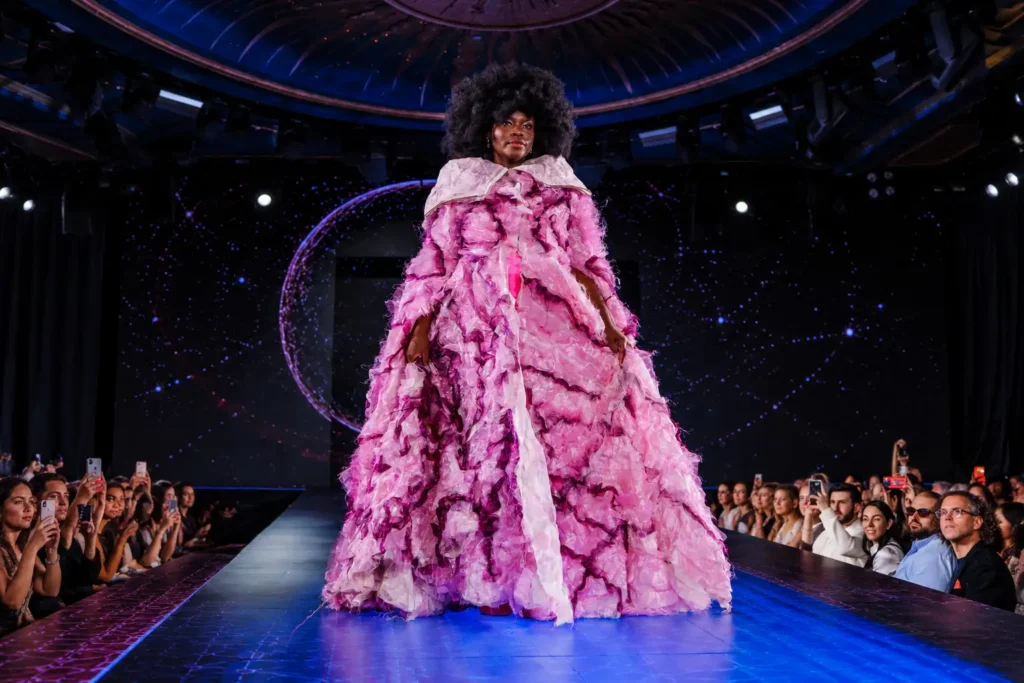
Then the opening of the show came back into focus. Kristin Renee Young, who had first appeared at the center of the red opening performance, returned to the runway. This time she was not there to sing. She was walking for Australia.
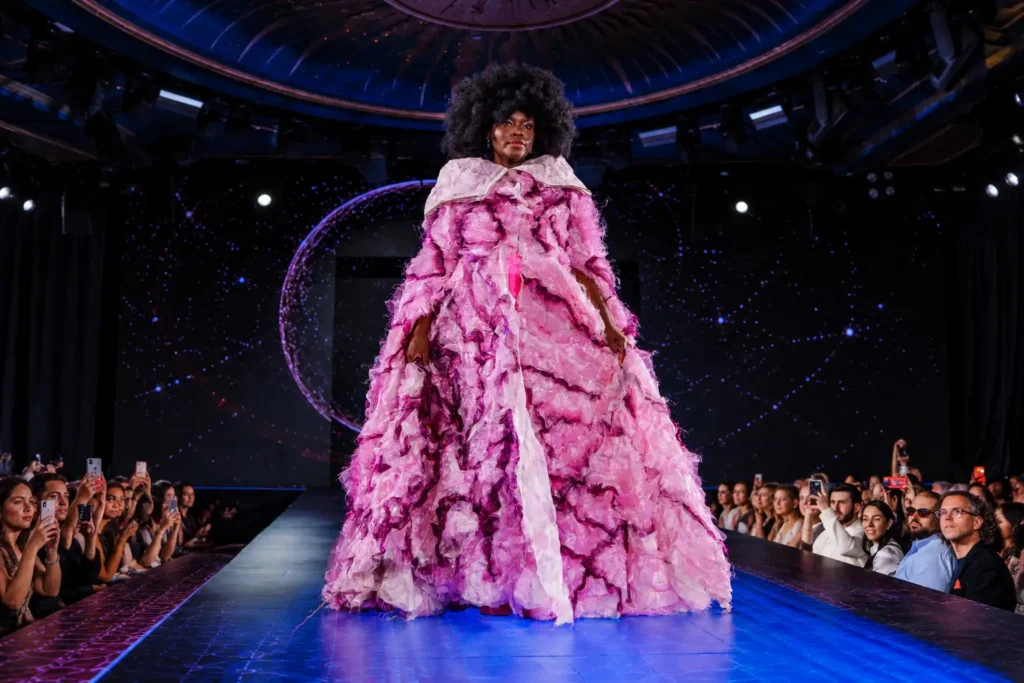
Her pink, magenta and white gown was impossible to miss. Layer after layer of lightweight material expanded around her, while a large white collar framed her face. What made the entrance memorable, though, was recognizing the person inside it. We had first experienced Young through her voice; now she had become part of the fashion presentation itself.
The international segment eventually returned to Canada with a vivid lime-green look defined almost entirely by texture. Large gathered sections surrounded the body like oversized blooms, turning one color into something surprisingly dimensional. With that final burst of green, the first part of HIV Unwrapped came to an end. Ten looks had moved through Sony Hall, each with a distinct point of view.
When Science Entered the Runway
The format changed for the second half. The U.S. Scientists Collection featured 10 completely new garments inspired by the work of 10 HIV scientists and researchers in the United States. For the project, the scientists were paired with emerging designers, primarily from Parsons School of Design, using their research, experiences and conversations as starting points for the clothes.
From the audience, the most important change was the way each look was introduced. Before a model appeared, a video played on the screens showing the scientist and designer connected to that collaboration. We met the two people behind the idea first, then the lights returned to the runway and we saw how their exchange had been translated into clothing. Conversation came first, fashion second.
Ten Conversations Become Ten Looks
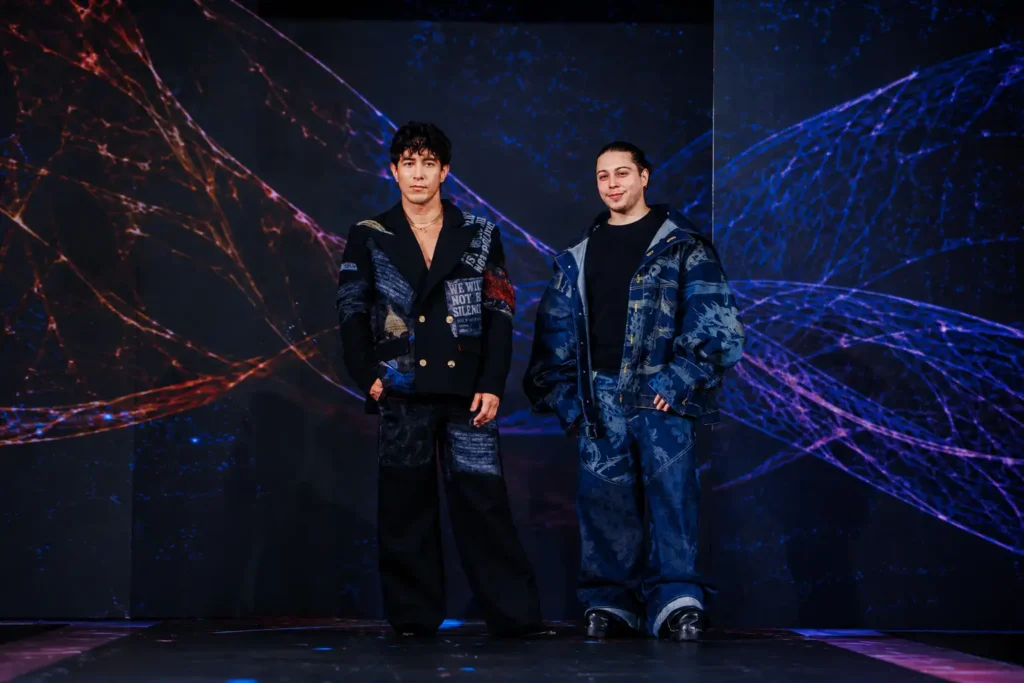
The first pairing introduced Jirair Ratevosian and Giani Rocha-Barnes. Their dark tailored look was covered with fragments of text, images and distressed-looking graphics. Among them, one message stood out clearly: “WE WILL NOT BE SILENCED.” Because we had just seen the pair speaking on screen, the garment arrived with a story already attached to it.
Shibani Mukerji and Ellen Amiryan followed with one of the most colorful pieces of the section. Knitted and woven fragments in red, orange, yellow, green, blue and white came together around the body, with long cords extending from the shoulders. When the model raised his arms, those elements spread outward and the silhouette suddenly became much larger.
Francisco Ruiz and Joelle Helenna shifted the room toward something more theatrical. Their shimmering asymmetrical look moved through long strips of fabric, while the styling and the model’s performance gave the entrance a sense of drama. Ryan Tu and Demetre C. Daskalakis changed the pace again with a relaxed blue look that moved from electric blue into paler shades and ended with silver boots.
With Laron Nelson and Garrett Ferrara, volume returned. A translucent beige garment floated around the body through wide sleeves and a sweeping skirt. The model used that volume while posing, lifting and shifting the fabric so the shape seemed to change in front of us. Five collaborations in, the second segment was already moving between completely different moods rather than repeating one visual formula.
From Everyday Clothing to the Lab Coat
Zara Annette and Renata Arrington Sanders led into a look that felt closer to recognizable everyday dressing: a bright turquoise shirt, an animal-print outer layer and a dark skirt finished with blue lace. After several more experimental silhouettes, the familiarity of the pieces made the combination stand out in a different way.
The collaboration between Allison Agwu and Anthony Zei brought the laboratory more visibly onto the runway. White dominated the look, and the long outer layer immediately recalled a lab coat, but strong red sections around the arms and irregular red details across the trousers transformed the reference into something made for the show.
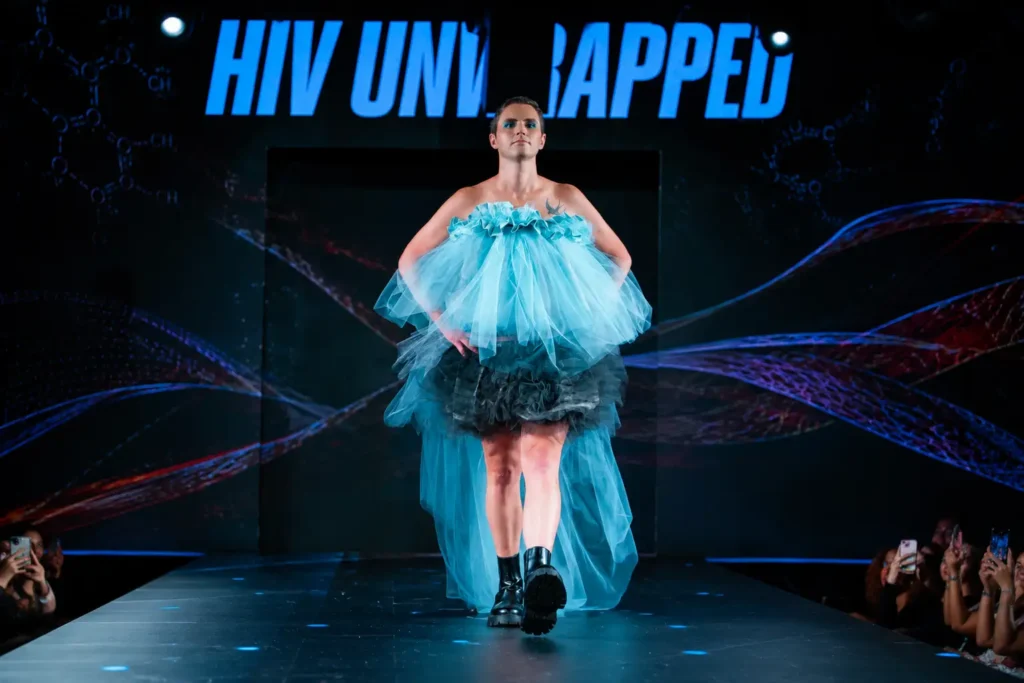
Then came Ahmad Farroukh and Keri N. Althoff, and the silhouette changed completely. Layers of blue tulle expanded outward from the chest into a huge rounded shape before narrowing toward the legs, with darker layers underneath and longer sections falling behind. This was a look you understood from across the room. Before any individual detail, you noticed its proportions.
A Final Shift in Proportion
The ninth collaboration, between Judith D. Auerbach and Tiho Kurz, stripped the palette back almost entirely to white. A fitted tank and open jacket sat above dramatically wide trousers built from overlapping panels. As the model walked, those layers separated and came back together, shifting the visual weight of the silhouette toward the lower half of the body.
The final pairing brought Adam Ward and Mason Strange to the screens. Their look closed the U.S. Scientists Collection with a quieter silhouette: a light, semi-transparent white top with extended shoulders paired with deep navy trousers and a sharply defined waist. After nine very different interpretations, the restraint gave the segment a natural ending.
By then, we had watched ten conversations move from screen to runway, each becoming something different once it reached the body.
One Final Walk
The show was not quite finished. For the finale, the looks returned to the runway together, bringing back the colors, oversized proportions, translucent layers, graphic surfaces and quieter tailored pieces we had seen throughout the presentation.
Seeing them in the same space made the scale of HIV Unwrapped much clearer. The international collection had brought together perspectives from seven countries, while the second segment had turned exchanges between U.S. HIV scientists, researchers and emerging designers into ten new garments. Karl Schmid returned with the looks to close the show.
It was a very different image from the one that had opened the night. HIV Unwrapped had begun with one voice at the center of Sony Hall, surrounded by red fabric, figures dressed in black and individual points of white light. Now the runway was filled with the people and clothing that had carried the presentation forward.
And that was what stayed with me after the final walk. The clothes were never asked to explain HIV on their own. They were part of a much larger conversation happening around them through music, research, personal perspectives, performance and the people occupying the runway.
At Sony Hall, HIV Unwrapped used fashion as a way into that conversation. By the end of the night, science and design no longer felt like two separate worlds brought together for a show. For a few hours, they were simply telling the same story in different ways.